
Published on: 16/12/2025
There is no fear in love, but perfect love casts out fear.
1 John 4:18
Dear friends,
Many of you have raised concerns about the rise of hostility to immigration, expressed through Union flags and St George Cross flags hung on our streets. So, we have put together a list of articles and ideas which may help you and your community to listen, talk about, and address these challenges. We have also included Bishop Pete’s Remembrance Day sermon, in which he gives his views on what is happening.
It is important to remind ourselves that we belong to a different kind of kingdom, one marked by love, justice, equity, respect and hospitality. We love our country, but we are also called to love one another as Jesus has loved us (John 13:34), and love casts out all fear (1 John 4:18). Therefore, as Christians we are called by Jesus to embrace each other, and to create safe spaces in which everyone can find a home in our communities.
Please let us know how things are going in your communities.
In prayers for your ministry,
Rev Anesia Nascimento de Jesus Cook,
Racial Justice Officer – Diocese of Sheffield
Articles to provide food for thought and talking points
Rt Rev. Philip North, Bishop of Blackburn
Rt Rev Graham Usher, Bishop of Norwich
BBC: Tommy Robinson supporters are turning to Christianity, leaving the Church in a dilemma
Church Times: Clergy express reservations about increasing flurry of flags on display
Church Urban Fund’s response to the rise in use of St George’s cross and Union flags
Theos Thinktank – (Re)Capture the flag
Ideas for engagement
Here are a few ways we can offer love, to challenge the hate directed at asylum seekers and refugees, and embody unity, community, compassion, and justice.
- The Churches can respond to the St George’s flag by discussing its symbolism, to promote Christian values like courage and hospitality, engaging with flag-flyers to understand their concerns.
- Emphasise St George’s Christian values: Connect the flag to the story of St George as a Christian who defended the vulnerable and stood against injustice, rather than as a symbol of hate or hostility.
- Engage in dialogue: Invite flag-flyers in for discussion: Create opportunities for conversation to understand the feelings and motivations behind flying the flag.
- It is important to involve as many as possible in this conversation, especially other denominations and community groups.
- The process must be handled sensitively by listening to community voices and on a case-by-case basis.
- Listen to concerns: Acknowledge and validate the fears of those who feel a growing intolerance but also listen to the anger of communities who feel their national identity is being taken away.
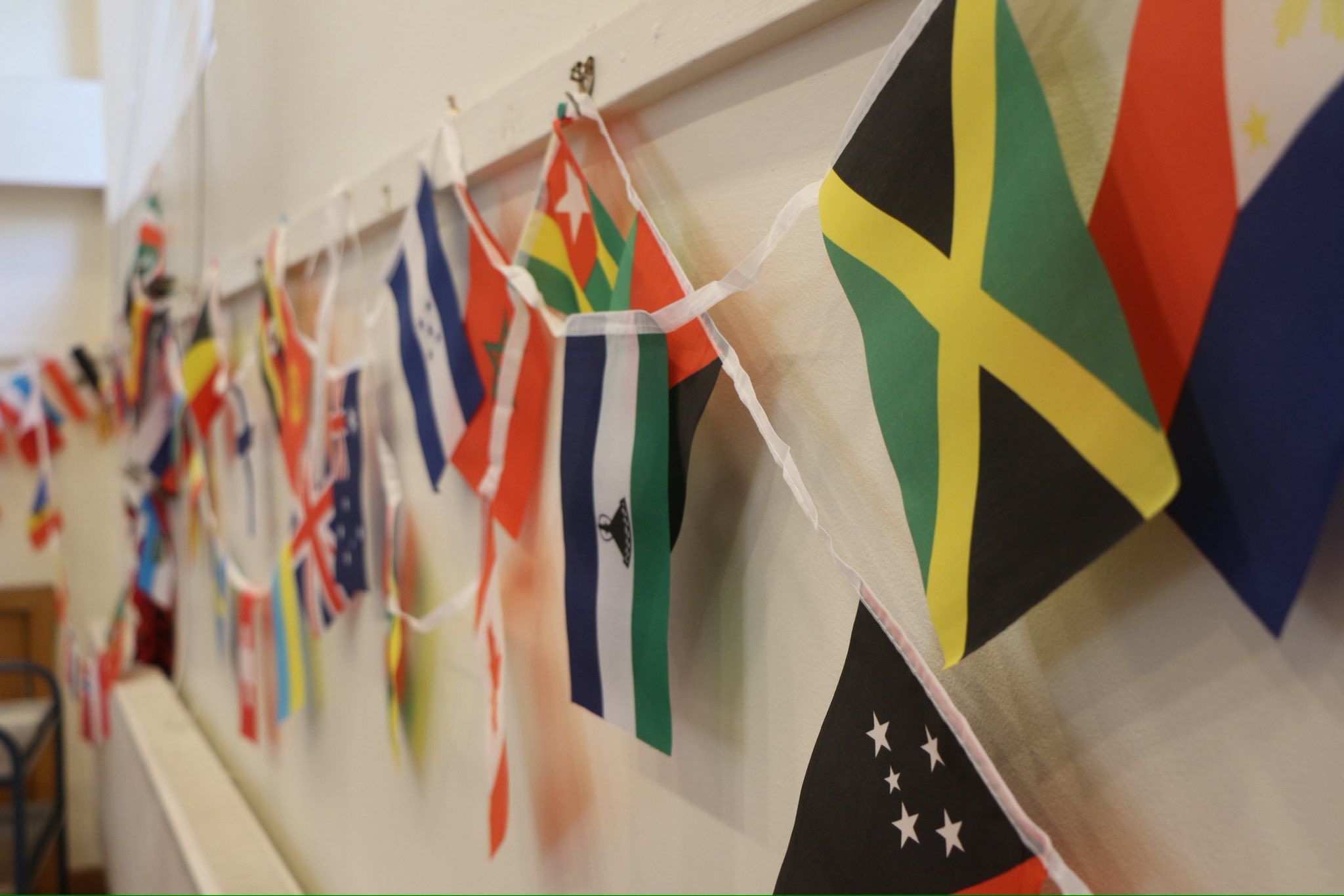
- Host community events, ask people to bring or make flags of where their relatives and friends live or originated from.
- Promote Gospel values: Speak words of peace and reconciliation into the conflict, using the cross of St. George as a symbol of Jesus Christ’s work that reconciles people to God and to one another.
- Establish a clear policy: Decide whether to fly the St George’s flag and communicate the church’s decision to the congregation and community.
- Consider flying other flags: The church can fly other flags, such as the Union flag or the flag of the Commonwealth, as long as they are maintained in good condition, according to The Church of England and The Flag Institute.
- Getting in touch with the council (councillors) is the first step as this will trigger the process of assessment and potential removal.
- Learn the facts about refugees and asylum seekers: Perhaps you or your church could offer support to staff, volunteers and asylum seekers and refugees?
13. Learn about the impact of poverty which extends far beyond a lack of financial resources. This includes poverty of identity, poverty of resources and poverty of relationships: https://cuf.org.uk/resources/web-of-poverty
14. Use the Church Urban Fund ‘Look Up Tool’ to find out more about poverty in your community: https://cuf.org.uk/lookup-tool. (Church Urban Fund is a national charity working with local leaders, churches and other faith groups all over England)
15. Call out hate when you see it and offer love and community as an alternative.
16. Display messages of hope, welcoming and belonging. It is about community not individuals; peace not conflict; solidarity not self-interest. https://hopenothate.org.uk/
17. Getting in touch with the council (councillors) is the first step as this will trigger the process of assessment and potential removal.
How We Can Challenge Right-Wing Christianity in Our Church
The Rt. Rev Tim Wambunya, Bishop of Wolverhampton
Founder Chair of ANIC- Anglican Network of Intercultural Churches
Right-wing Christianity often asserts itself loudly but rarely reflects the full extent of God’s kingdom. We can all challenge this distortion by offering a more faithful, Christ-centred witness.
We do this by returning to Scripture’s call for justice, mercy, humility, and neighbourly love. We speak out when any teaching excludes, demeans, or marginalises the vulnerable. We build alliances across cultures and denominations, demonstrating unity instead of fear. And we share stories of how God is at work in diverse communities, reminding others that the gospel liberates rather than controls.
By practising courage, truthfulness, and generosity, we help to restore the public voice of Christianity for the good of all.
Remembrance Sunday at Thorne, 09.11.25
Romans 8.31-39
By The Rt Rev Bishop Pete, Bishop of Sheffield
Dear friends, I have a widowed aunt, called Sheila. She lives in a care home in Redcar. She’s 98, pushing 99. She and her husband John, who died 9 years ago, had no children, so my siblings and I, her nieces and nephews, are her nearest and dearest. And since my brother and sisters live down south, I am in effect her next of kin. In fact, I have power of attorney to manage her affairs.
So about every couple of months, my wife Cathy and I do the two hour drive to visit.
And the remarkable thing about Sheila is that although her body is frail, her mind is still sharp as a tack. In particular her memory remains sound: her short-term memory is great, so she can tell us what she had for lunch that day or what happened on her most recent visit to hospital; and her long-term memory is great, so she can reminisce with us about her youth.
She was born in 1928, so she has, for example, vivid first-hand memories of the second world war.
Not everyone at such an advanced age is so fortunate. Many of us have had the distressing experience of caring for loved ones whose memories have failed, to the extent that they can no longer even recognise close family members. It’s tragic when that happens, because our memories are partly what makes us what we are. Memories help individuals to retain a sense of their identity.
And friends, it’s the same with communities. Shared memories help neighbourhoods, towns, nations retain a sense of identity.
That’s why occasions like this are so important, when we come together very deliberately to remember, to remember where we have come from, to remember what has made us the country, the community we are. If we don’t remember the past, we will lose any sense of our identity in the present, and that will diminish our capacity to shape a future together.
And I think I’m right that this is also what the debate about flags in recent months, the debate about the union flag and the St George’s flag, the debate about the flags which have quite suddenly appeared in such great numbers on our streets, hanging from lamp-posts, draped across roundabouts and stuck to road bridges, I think that’s really what the flags debate has been about.
It’s been about our corporate memory, about our national memory, about the kind of nation we have been, the kind of nation we are and the kind of nation we want to be. The controversy around flags indicates a crisis of remembrance.
I assume you’re aware the flags have become a bit divisive. Not everyone has been thrilled to see them – some people have felt intimidated by them.
It has felt to these people, as if the flags are being claimed by just one part of our society, one part of our nation, and is being used to exclude them, to tell them they are not welcome.
And here I’m not just referring to refugees and asylum seekers, though I include them. I mean British citizens, who have lived among us for decades, but who are not white: second and third generation British citizens, whose forebears came from across the Commonwealth to settle in this country decades ago. And others, as white British as you can get, especially from more prosperous middle class parts of the country have shared their anxiety, that the flags are being used to communicate a basically hostile message.
So it has been easy in some parts of our nation to demonise the people who have been flying the flags and to write them off as extreme right-wingers. But it’s not as simple as that. I know that in many of the communities I serve across South Yorkshire, the flags are a cry for help and a plea for fairness.
They have been flown by people who don’t feel that our political system has served them well in recent decades, who feel overlooked and undervalued, and who long for a renewal of the values those flags once so clearly represented. The flags are a call to us all to remember, to remember where we have come from, to remember what has made us the country and people we are, and the country and people we want to be.
And I need hardly remind you that just one symbol, just one, adorns both the flag of St George and the Union flag – and it is the cross, the Christian cross, the cross of our Saviour Jesus Christ. In fact, the Union flag is called that because it is the union of three flags, a combination of three flags: the Scottish flag of St Andrew, the Irish flag of St Patrick and the English flag of St George and each of the three flags bears a cross – in the case of St Patrick and St Andrew a diagonal cross, and in the case of St George the vertical cross. But all three point us to Jesus, whose death on a cross was a sacrifice to win the salvation of the world.
Friends, he is the one, our Lord Jesus is the one, and he alone I believe, who can mend this nation and unite it again, as we gather at the foot of his cross. But we can do our part by remembering him.
Who was it after all, who inspired several generations of our forebears to give up their own lives in sacrifice for others, in not one but two world wars, except Jesus, who told us that he himself came not to be served but to serve and to give his life as a ransom for many. Again, who was it who inspired several generations of our forebears to give up their own lives in sacrifice for others, in not one but two world wars, except Jesus, who told us that there is no greater love than this, for people to lay down their lives for their friends.
Friends, you will all have been horrified, as I was, by the stabbings on the Doncaster to King’s Cross train on Saturday evening a week ago and you were probably moved, as I was, to hear about the extraordinary courage of an LNER member of staff, who apparently made himself into a shield by putting himself between the attacker and a young girl.
I believe he remains in a critical condition, having sustained slash wounds to his chest and neck. I hope I would be as brave as him if I ever found myself in that situation. As an illustration of what it means to follow the example of Jesus, I can’t think of anything better.
The man’s name is Samir Zoutini. That’s not a traditional British name, but my goodness he has modelled for us traditional British behaviour, Christian behaviour, modelled on Jesus.
And that brings me, finally, to the verses of our Bible reading, read so beautifully for us by the deputy lieutenant a few moments ago. These are words of the Apostle Paul, written to one of the earliest churches, one of the earliest communities of Jesus’ followers, in the city of Rome, probably within 30 years of our Saviour’s death to support and encourage them.
And what’s most striking to me is that he doesn’t promise them their lives are going to be easy, that they are going to enjoy wealth and health and happiness. He promises them that if they hold fast to Jesus, then nothing bad, however bad, not even death itself, will be able to separate them from the love of God.
That vision of hope, and of life even beyond death, that vision is the birth right of every Christian and it really is a vision which can liberate us to live well in the present moment. If you know that your future is secure, that your destiny is assured, even eternally, not just for this life but for ever, it does strengthen you to endure the disappointments and distresses that are all too common, and it frees you to give yourself in loving service to others.
That seems to me to be a British vision, a British value: dignity and endurance in the face of adversity, and hope about our final destiny, which frees us to serve.
In other words, dear friends, our Bible reading this morning reminds us that it isn’t just the past that we can remember, it’s not just our history.
In a funny way, we can also remember the future, we can remember our destiny. On this Remembrance Sunday we do indeed we remember the past, we remember in particular the individuals whose names are carved into this memorial. We do so, to remember where we have come from, to remember what has made us the country and people we are, to refocus our attention on the sort of country and people we want to be in the years to come.
And as a focus for that Remembrance, the calling to mind of our history, I really cannot think of a better symbol, especially this year, that this flag, which recalls Jesus for us not once but three times over.
But as we remember our history, let us also remember our destiny, which is to be caught up through Jesus in the love of God for all eternity.
And let that assurance, that confidence, that hope, strengthen us to endure whatever distress or disappointment this life may bring us and let it free us to offer ourselves in the service of others. In the name of the Father and of the Son and of the Holy Spirit. Amen.