



8 February 2026 marks Racial Justice Sunday (RJS).
Racial Justice Sunday (RJS) takes place at the end of Race Equality Week (2 to 8 Feb – #ChangeNeedsAllOfUs). RJS began following the racist murder of Stephen Lawrence in April 1993 when the family’s Methodist church committed to supporting their campaign for justice. After a few years, Churches Together in Britain and Ireland (CTBI) helped RJS become a mainstream event for all churches and denominations and in 2017 it moved from September to its home on the second Sunday of February.
This year the theme ‘Love Your Neighbour’ gives opportunity to explore what it really means to love our neighbour. The CofE Racial Justice page quotes Richard Reddie of Churches Together, saying:
“In these resources, we explore what it really means to love our neighbour, especially given the current narratives of hostility, fear, suspicion and hatred of the ‘other’, particularly asylum seekers, refugees and anyone who is not British or Irish ‘enough’.
“We discuss how the Bible provides a blueprint for a world where everyone belongs; where everyone is loved, valued, and affirmed for who they are, not for what they look like or what they have to offer. And one in which our identity is ultimately to be found in Christ, as brothers and sisters of one ‘race’: the human race.
“I believe that this message is ‘for such a time as this’ (Esther 4:14). It is one that speaks through the ‘flags’, banners, protests and invective, relaying a message of unity and hope. Just as the greatest commandment speaks about loving God and one another, Jesus’ sacrificial death on the cross offers us all the hope of being united with God and with one another.
“Let us use Racial Justice Sunday (and other Sundays) to stand together in love, rejecting those words, actions and behaviours that go against Christ’s teachings, and embracing those biblical principles that foment unity, cohesion and engagement.”
Richard Reddie
Director of Justice and Inclusion, Churches Together in Britain and Ireland
For the whole law is summed up in a single commandment, ‘You shall love your neighbour as yourself’. Galatians 5:14
Resources
Liturgical Resources from The Church of England
This is a page that introduces the issues and vulnerabilities and how this work is aligned with the Six Pastoral Principles. The PDF of liturgical resources, linked at the bottom of the page, also include worship songs and hymns as well as links to Assembly/Collective Worship resources for schools and Bible Study and Tearfund’s Youth resources.
We would particularly recommend this ‘Love Your Neighbour’ toolkit/Resource booklet for 2026 from Churches Together (CTBI) which contains:
- Liturgical resources including Hymns, worship songs and bible readings as well as Prayer Station and Creative reading and prayer activities
- Sermons, homilies and reflections from six different perspectives
- And a Taking Action Section with Activities and Resources for Congregations, including questions and thoughts for reflection and further reading (books, reports and links)
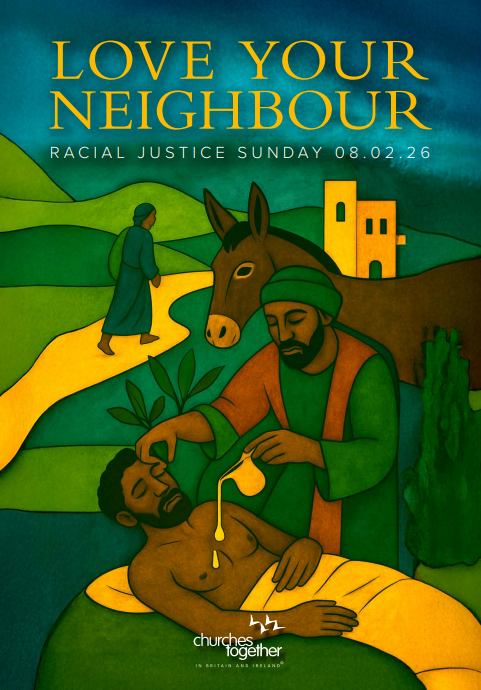
We hope you will find something fruitful for your particular context and do please let us know if you have any queries or feedback. We’d also love to hear how the resources are received so please do share any good news stories!
Racial Justice Leaflet
Preparing to mark Racial Justice Sunday, we hope this leaflet could help you to engage in conversations regarding racial inclusion as it gives some Gospel imperatives and simple terminology which might encourage people to reflect on their own practices. It is available to download, or can be posted out. Let us know how many copies you would find useful at racial.justice@sheffield.anglican.org. The content of the leaflet is also available below.
Christians as Confident Anti-Racists
With such a breadth of communities in the Diocese of Sheffield, people in South Yorkshire and the East Riding are more aware than many of the impact of discrimination, poverty, and legacies of oppression.
So, in a place proud of its record in standing up against injustices, we seek to empower Christians to have the confidence to sow seeds of Christ Jesus’s radical love, bringing gospel unity where loud voices have sought fear and division.
Gospel Imperative
1 Corinthians 12:25–27
…there should be no division in the body, but that its parts should have equal concern for each other.
If one part suffers, every part suffers with it; if one part is honoured, every part rejoices with it.
Now you are the body of Christ, and each one of you is a part of it.
Revelation 7:9
After this I looked, and there before me was a great multitude that no one could count, from every nation, tribe, people and language, standing before the throne and before the Lamb. They were wearing white robes and were holding palm branches in their hands.
Key Terms
We’re all learning together, so here are some terms that you might find it helpful to know more about:
Racial justice
Fair and equal treatment of everyone regardless of ethnicity or race.
Race
A social construct based on physical traits, created to enforce power. Though not biological, it shapes lives and identities.
Ethnicity
Shared cultural heritage, including ancestry, language, religion, and traditions.
UK Minority/Minoritised Ethnic (UKME) is preferred over BAME to better reflect UK diversity.
Global Majority Heritage (GMH) highlights that these cultures represent most of the world, though they are minorities in the UK.
Racism
Any discrimination based on race or ethnicity, including abuse, exclusion, or unequal systems.
Microaggressions are everyday actions or comments that subtly demean people.
Anti-Racist
Actively challenging racism by supporting those affected, listening, and speaking out against discrimination and microaggressions.
Because God loves every person in His beautifully diverse human family, we celebrate each other’s unique gifts to help build stronger, more vibrant communities where people find connection and enjoy learning from one another.
We’d love to talk to you about the community you serve and where this work might support people to understand why this issue is relevant to them.