


Published on: 28/07/2026
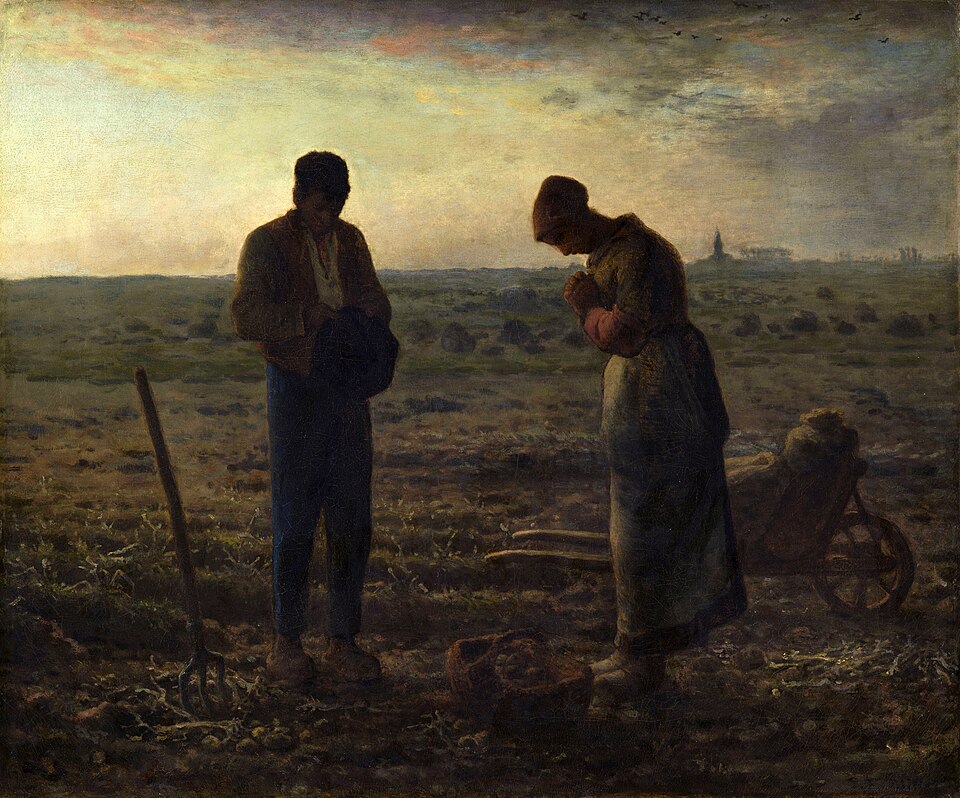
One of my favourite paintings is Jean-François Millet’s Angelus, which is a reflection on working life and faith. As you can see above, the Angelus focuses on two people at the end of a day spent harvesting potatoes. It would have been tough, heavy work, hard on the hands, the shoulders, the feet and the spine. It would have been work which paid just enough to make it through the day. The sun is setting, so these beleaguered figures are shrouded in a dusky anonymity. This man and this woman could be anyone who knows what it means to exhaust a human body for little or no reward. They could be anyone working their way through a cost-of-living crisis. They could be you or I, or the stranger dozing on the way home at the back of the bus. As they could be anybody, they represent everybody. All who labour and are heavy laden…
The inspiration that I draw from Millet’s painting is that God is in the fields with this hard-working couple. The Angelus is a Catholic prayer that interrupts the working day, with the church bells of nineteenth-century France, the time and place where Millet lived, chiming out at 6am, noon, and 6pm to call people to put down their work and pray. The church spire piercing the horizon in the background brings the sound of these church bells to mind, and the dark sky suggests that it is time for the 6pm Angelus, the end of the working day. Instead of collapsing into a haze of Instagram, dinner plans and television at the end of the working day (as has often been my way), these potato farmers remember the incarnation, how faithfully Mary yielded her will to God’s plans, and the inheritance that we share with Christ. In doing so, they sanctify their working day; what they might have viewed as taxing work with a temporary reward become a holy task in which God is invested and incarnate.
1 Corinthians 15:58 assures us that our labour is not in vain. This assurance comes after Paul shares the vision that the perishable will be clothed with the imperishable, and the mortal with immortality. A working day may feel like a waste of time, potatoes may be eaten quickly or rot away, but in the Kingdom of God these things become eternal and sacred.
I suspect that very few potato farmers attend church in the Diocese of Sheffield today. However, Millet’s Angelus answers the question of whether our laborious, ‘secular’ employment is worth it, whether God cares about the working lives of his people. This is a question that resonates with many who will sit in church this Sunday seeking relevance for they have to do on Monday morning. It is prayer that welcomes God into the days that we dare to label as ‘secular’ and transforms something as simple as potato harvesting into a holy act.
I’ll finish my thoughts with the final sentences of the Angelus prayer:
Pour forth, we beseech Thee, O Lord, Thy grace into our hearts, that we to whom the Incarnation of Christ Thy Son was made known by the message of an angel, may by His Passion and Cross be brought to the glory of His Resurrection. Through the same Christ Our Lord. Amen.
If you’d like to speak to the Lights for Christ team about faith and discipleship in the workplace, intentional and fruitful living, or discipling other people in your church or community, we’d love to hear from you through our email: lightsforchrist@sheffield.anglican.org.
This week’s blog post has been written by Joe Goodchild, Assistant Lights for Christ Enabler